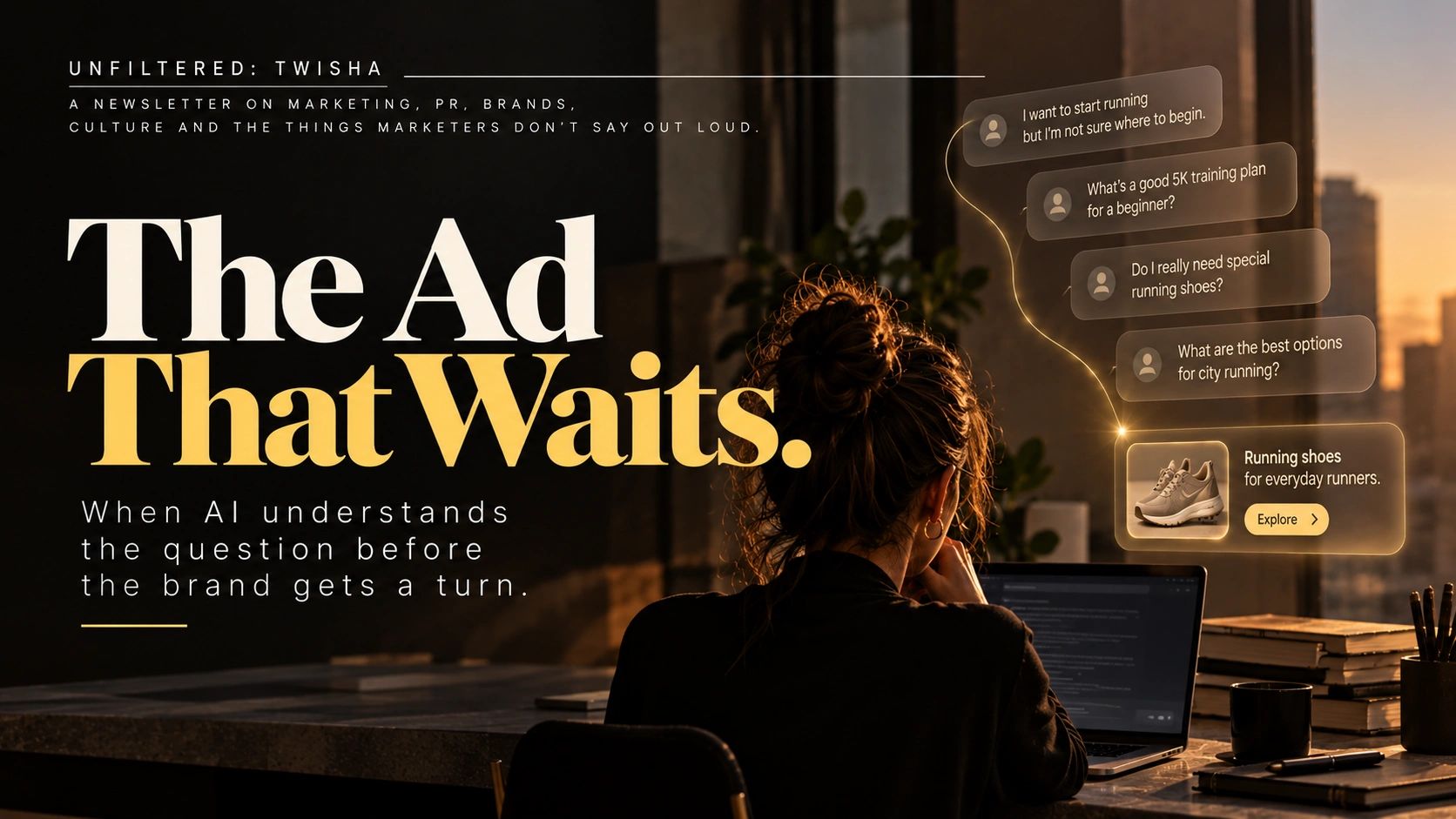
Advertising used to follow what we searched for. Now it's learning to understand what we're trying to do.
Unfiltered: Twisha | October 27, 2026
Imagine this.
On Monday, you ask an AI assistant how to start running.
On Wednesday, you're discussing training plans.
By Saturday, you're wondering whether you need proper running shoes.
You haven't searched for a particular shoe brand.
You haven't clicked on a product advertisement.
You haven't even decided to buy anything.
But across those conversations, something has changed.
Your curiosity has gradually become a potential purchase decision.
For years, advertising systems have been designed to identify moments like these through searches, browsing behaviour, audience segments and other signals.
Now they're learning to interpret the conversation itself.
And I think that deserves considerably more attention than another announcement about AI-generated advertising creatives.
Because this isn't simply changing how advertisements are made.
It's changing how advertising identifies the moment someone might be ready to listen.
Something significant happened on October 21.
Last week, OpenAI published a technical explanation of how its advertising system works.
The most interesting part wasn't the technology itself.
It was the philosophy behind it.
Traditional search advertising generally begins with a specific event.
Someone types a query.
The advertising system interprets it.
Relevant advertisers compete for placement.
A sponsored result appears.
Conversational AI presents a different challenge.
People don't always arrive knowing exactly what they want.
They explore possibilities.
Change their minds.
Introduce constraints.
Ask follow-up questions.
Sometimes they discover that the thing they originally wanted isn't actually what they need.
OpenAI's system is designed to interpret that evolving intent across a conversation.
Its architecture uses a separate AI model to identify potential advertising opportunities, retrieve relevant candidates, assess their suitability and run an auction.
The company also describes how the system maintains context across conversational turns, with additional historical signals available when users enable ad personalisation. OpenAI
In other words, the advertising system isn't simply asking:
What did this person type?
It's attempting to understand:
What is this person actually trying to accomplish?
That distinction changes the nature of the opportunity.
The most interesting feature might be the decision not to advertise.
There's a detail in the technical explanation that caught my attention.
The system doesn't have to show an advertisement every time it identifies something commercially relevant.
Sometimes, the appropriate outcome is no advertisement at all.
Think about how different that is from the advertising experiences we've become accustomed to.
We've spent years navigating websites where advertisements compete for every available space.
Videos interrupted by commercials.
Articles surrounded by banners.
Search results filled with sponsored placements.
Social feeds where paid content blends into organic discovery.
Much of digital advertising has been built around finding more opportunities to display a message.
Conversational advertising introduces another question:
Is this actually an appropriate moment to display one?
Of course, the commercial incentive to show advertising hasn't disappeared.
And a system designed to recognise useful moments isn't automatically going to make perfect decisions.
But the underlying design acknowledges something marketers should have recognised a long time ago.
Relevance isn't just about the right audience.
It's also about the right moment.
Sometimes the most useful thing a brand can do is wait.
Here's where I think brand strategy becomes more important, not less.
Consider two hypothetical furniture brands.
Both sell dining tables.
Both have attractive websites.
Both invest in photography and advertising.
But their product information is very different.
Brand A describes its dining table as:
An elegant addition to your contemporary living space.
Brand B explains the actual dimensions, seating capacity, materials, maintenance requirements, delivery conditions and assembly process.
Now imagine a customer asks an AI assistant:
I have a small apartment, two children and limited space. Which dining table would be practical?
Which brand has made it easier for someone to evaluate its product?
This isn't an argument against beautiful brand storytelling.
It's an argument for substance.
In a conversational environment, the questions customers ask can become increasingly specific.
A beautiful advertisement may create initial interest.
But when someone begins asking whether a product will fit their life, vague promises become less useful.
The next competitive advantage may belong to brands that can explain themselves as convincingly as they present themselves.
That requires better product information.
Clearer positioning.
Credible claims.
And a deeper understanding of the questions customers actually ask before making decisions.
Not simply more content.
Better answers.
But there's an uncomfortable question underneath all of this.
How much should an advertising system understand about us?
This is where the conversation becomes more complicated.
A system that understands the context of your question could make advertising considerably more useful.
You might discover something relevant without searching through dozens of websites.
You could compare alternatives more easily.
You might avoid advertisements for products that don't fit your requirements.
That's the optimistic interpretation.
But there's another side.
The more accurately a system interprets your intentions, the more important its privacy safeguards and commercial boundaries become.
OpenAI says its advertisements are clearly labelled and selected separately from ChatGPT's answers. Advertisers do not receive users' private conversations or memories. The company also says advertising is excluded from sensitive conversations, including personal health, mental health and politics. OpenAI Help Center
Those are important distinctions.
But they don't eliminate the broader question.
When does helpful personalisation become uncomfortable persuasion?
And who gets to decide where that boundary sits?
I don't think there's a simple answer.
Consumers want relevance.
Advertisers want efficiency.
Platforms want sustainable revenue.
Those interests can align.
But they aren't identical.
A system can be commercially effective without always being desirable from a consumer's perspective.
That's why transparency, user control and independent scrutiny matter.
The commercial momentum is already significant.
On October 21, Reuters reported that ChatGPT advertising had expanded into 26 additional countries, reaching 89 markets.
More than 100,000 advertisers had run campaigns.
OpenAI also reported that its advertising business had reached a $1 billion annualised revenue run rate in under 200 days.
An important distinction: an annualised run rate is a projection based on the current revenue pace, not a statement that $1 billion has already been earned over a full year. Reuters
Still, the speed of adoption is notable.
And the advertising experience itself is evolving.
On September 16, OpenAI announced tests of Sponsored Agents, which allow users who click an advertisement to begin a separate, clearly identified conversation with a business-sponsored assistant.
The feature was being tested with selected US advertisers, rather than being universally available. OpenAI
Think about what that could mean.
A traditional advertisement might tell you that a hotel has beautiful rooms.
A conversational advertisement could potentially help you explore whether those rooms meet your requirements.
One introduces the offer.
The other helps you investigate it.
That creates an opportunity for brands.
It also introduces a new responsibility.
If a sponsored assistant answers questions inaccurately, exaggerates benefits or creates misleading expectations, the damage won't necessarily be confined to the advertisement.
It could affect the customer's trust in the brand itself.
And this is why I think PR professionals should be paying attention.
Public relations has always been concerned with credibility.
Not simply visibility.
A brand can pay to communicate a message.
But earning trust requires something more.
A credible reputation.
Consistent behaviour.
Evidence that supports its claims.
Independent validation.
And the ability to withstand scrutiny.
Conversational advertising makes those qualities particularly relevant.
Because a customer doesn't have to accept the first message they receive.
They can question it.
Ask for comparisons.
Request clarification.
Challenge a claim.
Investigate alternatives.
The advertisement becomes the beginning of a discussion rather than the end of a message.
And that means the gap between what a brand promises and what it can actually demonstrate becomes harder to ignore.
I wouldn't go as far as saying AI will automatically reward the most trustworthy brands.
That hasn't been established.
But I do think conversational discovery creates a stronger practical incentive for brands to make their claims specific, consistent and verifiable.
A good advertisement can create curiosity. A credible brand must survive the questions that follow.
That's where marketing and PR increasingly intersect.
There's another metric I'd be careful about.
Earlier this month, OpenAI shared preliminary advertising measurement findings from partners.
One example involved Portland Leather.
According to measurement partner Triple Whale, 93% of the brand's visitors from ChatGPT Ads were new visitors.
That's interesting.
It suggests the advertising channel may help introduce brands to people who haven't previously visited their websites.
But there's an important distinction.
New visitors aren't the same as new customers.
And neither metric, on its own, establishes incremental profit.
The findings were also reported by partners during an early stage of the advertising platform's development. They shouldn't be treated as proof that every brand will achieve similar results. OpenAI
This is something I wish we discussed more often in marketing.
A platform announces impressive results.
The numbers circulate.
Agencies repeat them.
Brands begin experimenting.
But the underlying question often gets lost.
What actually improved for the business?
Did customers purchase?
Would those customers have arrived anyway?
Did the campaign generate profitable growth?
Did it improve brand consideration?
Or did it simply create another measurable interaction?
As AI advertising develops, I think measurement literacy will become just as important as technical literacy.
What happens to creativity?
Whenever AI changes advertising, we seem to return to the same debate.
Will it replace marketers?
Will it replace agencies?
Will it replace creative teams?
I think that framing misses something.
If an AI system becomes better at recognising commercial intent, brands still have to give people a compelling reason to choose them.
The system might identify someone looking for running shoes.
It doesn't automatically make one shoe brand more meaningful than another.
It might recognise someone planning a holiday.
It doesn't automatically create the emotional associations that make a particular destination appealing.
It might identify a customer comparing two products.
It doesn't automatically make either brand worth trusting.
Technology can improve the connection between a need and an offer.
But the quality of that offer still matters.
So does the brand behind it.
In fact, as advertising systems become more capable of identifying the right customer at the right moment, weak differentiation could become even more obvious.
Imagine two brands appearing in equally relevant contexts.
Both answer the customer's immediate question.
Both offer comparable functionality.
What makes someone choose one over the other?
That's where familiarity, reputation, experience, identity and trust enter the picture.
The fundamentals of brand building haven't disappeared.
The environment in which they operate is changing.
The shift I'm watching
For years, marketers have talked about reaching the right person with the right message at the right time.
Conversational advertising adds another dimension.
The system may increasingly understand why someone is considering a decision.
And that creates a different kind of marketing challenge.
Not simply attracting attention.
Not simply generating clicks.
But becoming genuinely useful during the process of making a decision.
I think the brands that navigate this well will understand something important.
Customers don't experience their needs as neatly organised marketing funnels.
They experience them as questions.
Uncertainty.
Comparisons.
Changing priorities.
Occasional hesitation.
And sometimes, a decision not to buy anything at all.
The best marketing should be able to accommodate that reality.
My takeaway
The next phase of advertising may become less about predicting which advertisement someone will click and more about understanding when a commercial message could actually help.
That has enormous potential.
It also creates difficult questions about privacy, persuasion, transparency and platform power.
And we shouldn't confuse technological sophistication with consumer benefit.
An advertisement that understands your intentions isn't necessarily an advertisement you want to see.
The real test isn't whether AI can recognise when we're ready to buy.
It's whether advertising can become more useful without becoming more intrusive.
That's the question I think the industry needs to answer.
Over to you
Imagine an AI assistant understands exactly what you're looking for.
It knows your requirements, your preferences and the questions you've been asking.
Would you welcome a relevant sponsored recommendation at that moment?
Or would knowing how much context the system understands make you less comfortable?
Would you trust advertising more if it understood you better, or less?
I'm curious where people draw that line.
UNFILTERED: TWISHA
Marketing, PR, technology, brands, culture and the things marketers don't say out loud.
Social media & brand strategist.
Founder, TM Marketing.