Unfiltered: Twisha | October 23, 2026
I have a question.
When did running an Instagram account become something you could upgrade like a Netflix subscription?
Not advertising. Not boosting a post.
I'm talking about the actual experience of managing and growing an account.
Because that's the part of Meta One I find fascinating.
In September, Meta introduced a new subscription structure across Instagram, Facebook, WhatsApp and Meta AI.
The headline was fairly straightforward: more AI, more creative tools, more features.
But buried inside the announcement was something that deserves a much bigger conversation.
Meta is beginning to put some of the tools that help businesses turn attention into customers behind a subscription.
And I think that tells us a lot about where social media is heading.
First, what exactly is Meta One?
Let's get the facts out of the way.
Meta One brings together paid features for everyday users, creators and businesses.
The core experience remains free.
But the paid plans offer additional capabilities, ranging from AI-generated content and account customisation to professional publishing tools, analytics and customer communication.
Meta's announced US starting prices include:
- $2.99/month for individual app plans
- $7.99/month for the Core consumer bundle
- $14.99/month for Essential creator and business plans
- $49.99/month for Advanced creator and business plans
- $149/month and $499/month for higher professional tiers
Pricing and availability vary by region and account.
But the prices aren't the most interesting part.
The features are.
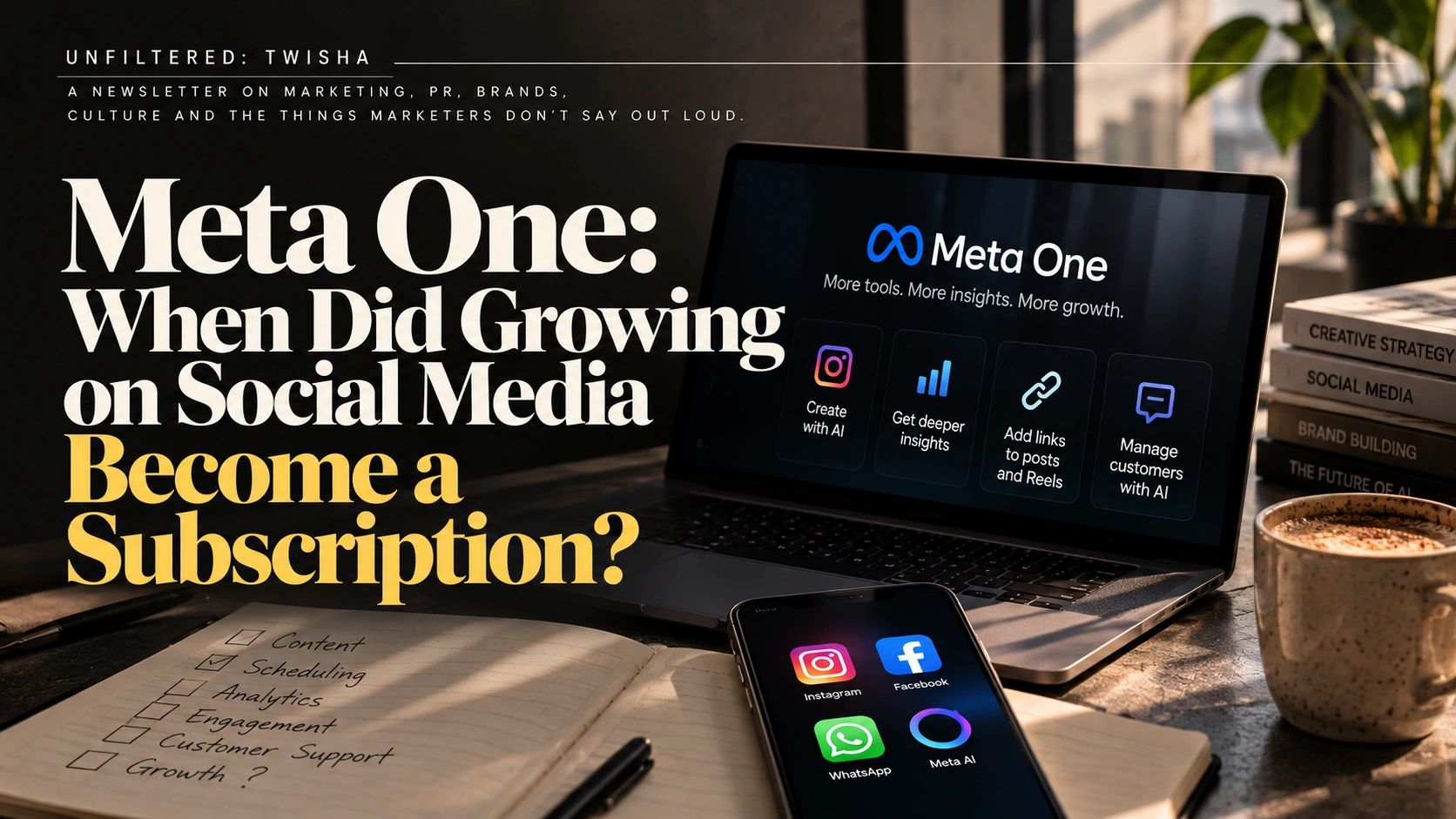
For example, the Advanced business plan includes the ability to add links directly to eligible Instagram posts and Reels, schedule Stories up to 30 days ahead, export analytics and access deeper audience insights.
Higher tiers offer expanded access and additional business capabilities.
And Meta is introducing more AI assistance into the process, including tools to respond to customer enquiries.
Think about that combination for a moment.
Content creation. Publishing. Discovery. Analytics. Customer service.
Activities that businesses often manage through several separate tools are increasingly being brought inside Meta's own ecosystem.
This is not simply a subscription for people who want prettier Instagram Stories.
It's the beginning of something much more commercially interesting.
Meta doesn't just want you to advertise anymore.
It wants to become your marketing workspace.
Imagine you run a small clothing brand.
Today, your workflow might look something like this:
You create graphics in Canva.
Edit videos in CapCut.
Schedule posts through another tool.
Check Instagram Insights.
Track results in a spreadsheet.
Respond to customer enquiries on WhatsApp.
And perhaps run paid ads through Meta Ads Manager.
Now imagine Meta gradually brings more of that workflow into one connected experience.
You create the content.
Schedule it.
Analyse its performance.
Receive AI-powered suggestions.
Manage enquiries.
And potentially convert customers without making them leave the platform.
That's a compelling proposition.
Especially for a small business that doesn't have a marketing department.
But there's another side to it.
The more of your business you operate inside Meta, the more dependent you become on Meta.
And that dependency is worth examining.
The Instagram link is a bigger deal than it looks.
For years, one of the most frustrating parts of Instagram marketing has been getting people to leave a post and visit a website.
Brands became remarkably creative at working around this.
"Link in bio."
"Comment LINK."
"DM us for details."
"Check our Stories."
Entire marketing workflows developed around moving someone from an Instagram post to the place where they could actually buy something.
Now Meta One introduces native links in certain organic posts and Reels for eligible paid subscribers.
This sounds like a small feature.
It isn't.
Because the distance between discovering a product and taking action matters enormously.
Imagine seeing a restaurant's new menu in a Reel.
You like it.
You want to book.
But you have to visit the profile, find the link, navigate a website and locate the reservation page.
Every additional action is another opportunity to abandon the process.
A direct link can remove some of that friction.
That's valuable.
But here's the question I can't ignore:
If a feature makes it easier for a business to convert interest into action, should it be a premium feature?
There isn't an obvious universal answer.
Meta is entitled to charge for professional tools.
Businesses routinely pay for software that saves time or improves operations.
But Instagram isn't just another software product.
For millions of businesses, it's also a major discovery channel.
That makes the distinction between optional convenience and commercially important functionality worth watching.
And to be clear, paying for Meta One does not mean Meta has promised your content more organic reach.
That would be a very different proposition.
There's a second story here: AI is becoming part of the operating system.
Most conversations about AI in marketing still revolve around content.
Can AI write a caption?
Can it create a Reel?
Can it generate a product photograph?
Useful questions, certainly.
But I think they're becoming the least interesting questions.
Earlier this month, Meta outlined additional capabilities for its AI business assistant, including more contextual recommendations and experiments with actions such as adjusting ad budgets through conversational instructions.
Some capabilities remain in testing.
Still, the direction is clear.
AI is moving from helping marketers produce content to helping them manage decisions and workflows.
That's a fundamental shift.
Consider the difference.
Old AI question: "Can you write five ad headlines?"
New AI question: "Which campaign is underperforming, what changed, and what should I do about it?"
The second question is considerably more valuable.
It's also more consequential.
Because when AI starts recommending budgets, interpreting performance and suggesting strategic decisions, marketers need to understand not only what the system recommends but why.
Otherwise, convenience can quickly become dependency.
A tool that helps you analyse your campaigns is useful.
A tool whose recommendations you accept without understanding them is a risk.
And I suspect that distinction will become increasingly important over the next few years.
Now here's the part that changes how I look at Meta's business.
According to Meta's September announcement, its subscription offerings had already reached 15 million subscriptions and trials.
That figure needs an important qualification.
It combines subscriptions and trials. It isn't a confirmed count of paying subscribers.
But it still indicates the scale of Meta's ambition.
Meta already makes enormous amounts of money from advertising.
Now it is developing another commercial relationship with the same ecosystem.
Businesses can pay Meta to advertise.
And businesses can also pay Meta for tools to manage their presence.
These are different products, serving different needs.
But strategically, they reinforce each other.
Meta doesn't necessarily need every business to subscribe.
It needs enough businesses to find the additional capabilities worth paying for.
And if those tools become embedded in daily operations, subscriptions may become a recurring part of a company's marketing budget.
This is where I think Meta One becomes more interesting than the launch headlines suggest.
It's not simply monetising features.
It's monetising the work of participating in the platform's economy.
So, should businesses actually pay?
This is where I'd push back against the excitement.
A subscription is not a strategy.
A verified badge doesn't automatically make your brand trustworthy.
Deeper analytics don't automatically mean better decisions.
An AI assistant doesn't automatically understand your customers.
And a direct link won't rescue content that nobody finds interesting.
I can already imagine businesses signing up because they feel they're falling behind.
That's exactly the wrong reason.
Before paying, I'd ask three questions.
1. What problem am I actually trying to solve?
If your biggest problem is that nobody remembers your brand, a scheduling upgrade won't fix that.
If your biggest problem is slow customer responses, an AI-assisted messaging tool might genuinely help.
2. Can I measure the value of this feature?
For example, if native links generate qualified website visits and measurable sales, you can evaluate whether the subscription pays for itself.
But if you're subscribing because the feature sounds impressive, you're buying a possibility, not a result.
3. Am I building a stronger business or becoming more dependent on one platform?
This is the question I find most important.
Your customers, relationships, website, email list and brand reputation have value beyond a single social platform.
An Instagram feature can help you grow.
But your entire customer relationship shouldn't depend on Instagram continuing to work exactly as it does today.
What I think marketers are missing
The discussion around Meta One has largely focused on which features cost what.
That's understandable.
People want to know whether a subscription is worth buying.
But the bigger question is what happens when the platforms that distribute attention also become the platforms selling more of the tools used to manage it.
There's an obvious benefit.
Smaller businesses may gain access to capabilities that previously required expensive software or specialised teams.
That's a genuine opportunity.
But there is also a structural tension.
When one company controls the environment, develops the tools, provides the analytics and sells additional services, businesses need to be thoughtful about how much of their operations they place inside that environment.
Not because Meta One is inherently bad.
But because convenience and control don't always move in the same direction.
And I don't think marketers discuss that trade-off nearly enough.
The part I'd watch next
Not subscriber counts.
Not how many AI features Meta announces.
I'd watch whether these tools actually change business outcomes.
Do direct links improve conversion?
Do AI assistants resolve customer questions accurately?
Do deeper insights lead to better marketing decisions?
Do businesses save enough time or money to justify the subscription?
And most importantly, do smaller brands gain meaningful capabilities, or do they simply acquire another monthly expense?
Those answers will tell us much more than a product launch ever could.
Because the real measure of a marketing tool isn't how impressive it looks in a demonstration.
It's whether it makes the business better.
One final thought
For years, social media platforms made it incredibly easy to create an account and start publishing.
That accessibility helped millions of creators and businesses build audiences.
Now we're watching a new layer emerge.
The basic experience remains free.
But additional tools for operating, analysing and converting attention increasingly come with a price.
Maybe that creates a better ecosystem.
Maybe it creates more dependence.
Probably, for different businesses, it will do a bit of both.
But it leaves me with one question.
When the platform becomes your publisher, analytics provider, AI assistant and customer service tool, how much of your business are you comfortable letting it control?
I'm genuinely curious where people stand on this.
Would you pay Meta for better tools to run your business, or would you rather keep your marketing operations independent?
And if you're already using Meta One, has anything actually improved?
I'd love to hear real experiences, not just opinions about the announcement.
Because that's where this conversation gets interesting.
Unfiltered: Twisha
Marketing, PR, technology, brands and the decisions shaping what comes next.
Social media & brand strategist.
Founder, TM Marketing.