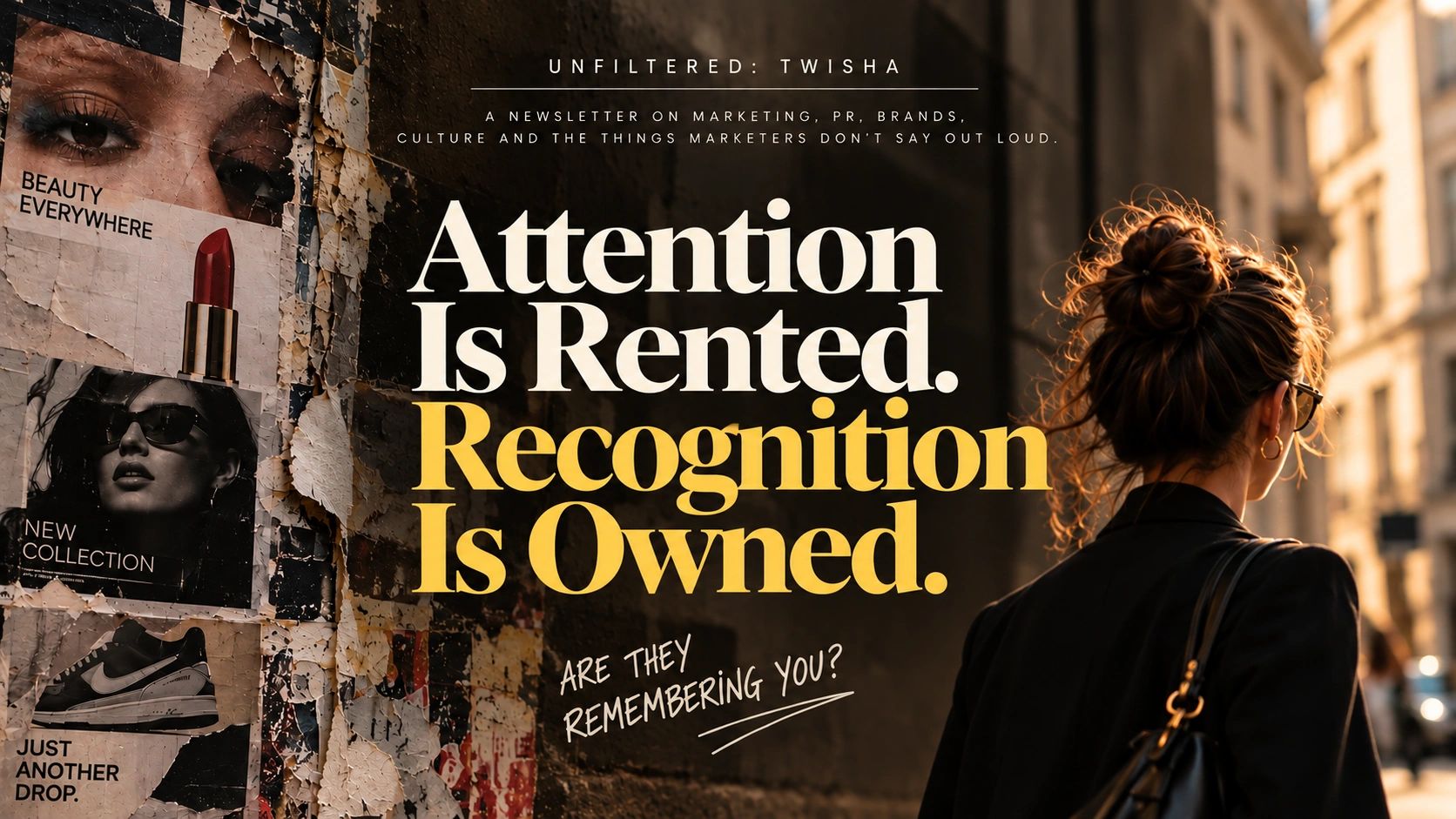
There is a marketing problem I think we keep naming incorrectly.
We say:
“Brands need more attention.”
I’m not convinced.
We have never had more ways to get attention.
Creators. TikTok. Reels. Podcasts. Influencers. AI-generated content. Brand collaborations. Memes. Newsjacking. Experiential campaigns. Even LinkedIn has become a creative playground.
The problem is what happens after someone looks.
Because being noticed for three seconds is not the same thing as being remembered three days later.
And in 2026, that distinction matters more than ever.
The internet is becoming very good at making brands visible.
It is becoming much worse at making them distinctive.
AI has made content production dramatically easier.
A brand can now produce ten captions, five videos, three campaign concepts and a dozen variations before lunch.
But when everyone can produce more, more stops being an advantage.
McKinsey’s analysis of Cannes Lions 2026 described the emerging problem as “mediocrity at scale”: AI can remove friction from production, but it can also flatten creative output when everyone is working from similar patterns.
That is why I think the next competitive advantage in marketing is not simply creativity.
It is recognition.
Can someone see something without the logo and still know it is you?
Can they hear the first three seconds of an ad and recognise the brand?
Can they describe what your brand stands for without repeating your website's About Us page?
Can they remember you when they actually need what you sell?
That is a much harder problem.
And much more valuable.
Look at what Vaseline did.
Vaseline could have behaved like a traditional heritage skincare brand.
Beautiful product shots.
“Deeply moisturising.”
“Trusted for generations.”
Influencer sends product.
Influencer says, “Guys, I’ve been loving this…”
Post.
Next.
Instead, Vaseline started listening to the internet.
People were already using petroleum jelly in unusual ways and sharing beauty hacks online.
Vaseline didn't simply interrupt those conversations.
It created Vaseline Verified to test and validate them.
That distinction is important.
The brand didn't manufacture a cultural conversation from scratch.
It found a conversation that already existed and gave the brand a credible role inside it.
The campaign generated more than 136 million social views and contributed to three consecutive years of double-digit growth, according to Vogue's reporting.
More importantly, the brand became associated with something beyond:
“petroleum jelly.”
It became associated with:
“the brand that knows what actually works.”
That's recognition.
Now look at the collaboration explosion.
Dunkin' × L.L.Bean.
JELL-O × Tower 28.
Peloton × Miley Cyrus.
Starbucks × Peanuts.
The list keeps getting longer.
And there is a reason.
Collaboration is an extremely efficient way to borrow attention.
Your audience knows Brand A.
Their audience knows Brand B.
Put them together, and suddenly there is a new reason to look.
The problem?
Attention can be borrowed. Meaning cannot.
A collaboration works when the combination creates something that neither brand could have created alone.
It fails when it is essentially:
Logo + Logo + limited edition = campaign.
Recent reporting on the collaboration boom makes the same point: consumers are increasingly able to distinguish genuinely interesting partnerships from brands simply using collaborations as a shortcut to relevance.
There is a question I would put on every brand's campaign brief:
“If we remove the logos, is there still an idea here?”
If the answer is no, you probably don't have a campaign.
You have a co-branded product announcement.
This is where social media strategy gets misunderstood.
A lot of brands still treat social as a publishing machine.
Monday: educational post.
Wednesday: reel.
Friday: product post.
Stories every day.
Repeat.
But audiences don't experience brands as content calendars.
They experience them as patterns.
The words you repeatedly use.
The humour you repeatedly make.
The visual codes you repeatedly own.
The opinions you repeatedly defend.
The communities you repeatedly show up for.
The things you refuse to say.
The way you respond when something happens in culture.
The people you choose to collaborate with.
Eventually, those repetitions create something much more powerful than individual posts.
They create memory structures.
And this is why consistency is not the same as posting regularly.
Consistency means:
“I know what this brand would probably say.”
That is a very different achievement.
Here's the uncomfortable part.
Your audience probably doesn't need another post from you today.
They need a reason to remember you.
That might mean posting less.
It might mean having a stronger point of view.
It might mean repeating an idea instead of constantly inventing new ones.
It might mean developing a recognisable visual language.
It might mean saying something slightly uncomfortable that your competitors wouldn't say.
Or it might mean becoming useful in a very specific cultural conversation.
Because distinctiveness requires repetition.
And marketers are often terrified of repetition.
We think:
“They've already seen this.”
But brands need to remember something creators sometimes forget:
You are thinking about your brand far more than your audience is.
You have seen the campaign 47 times.
Your customer may have seen it once while scrolling at 11:43 p.m.
What feels repetitive to the brand can feel consistent to the audience.
So I would change the question.
Don't ask:
“How do we get more people to see this?”
Ask:
“What do we want them to remember after they see it?”
Then ask:
“What can we repeat often enough that it becomes associated with us?”
That's the beginning of brand strategy.
A simple test I use:
Imagine your brand disappears from Instagram tomorrow.
No logo.
No handle.
No bio.
No product tag.
Now show someone five pieces of content from your competitors and one piece from your brand.
Can they identify yours?
If they can't, you don't necessarily have an awareness problem.
You may have a distinctiveness problem.
And throwing more content at a distinctiveness problem usually creates more noise, not more memory.
One more thing: AI makes this even more important.
94% of social media marketers surveyed by HubSpot in 2026 said they use AI in their workflows, while 77% said authenticity is more important than production value.
That tells me something interesting.
The future isn't:
Human vs AI.
It's:
Generic vs distinctive.
AI can help you produce faster.
It cannot decide what your brand should be known for.
It can generate 100 ideas.
It cannot guarantee that one of them deserves to exist.
It can imitate a tone.
It cannot give you a reason to have that tone.
That part still requires judgment.
Taste.
Cultural awareness.
And occasionally, the courage to say:
“No. Everyone else is doing this. Let's do something else.”
My takeaway
The brands I think will win the next few years won't necessarily be the brands producing the most content.
They'll be the brands that become easiest to recognise, describe and remember.
Because attention is temporary.
Recognition compounds.
And once people recognise you, you don't have to introduce yourself from zero every time.
That's the real advantage of a brand.
YOUR TURN
Think of one brand you could recognise without seeing its logo.
Maybe you recognise its colour.
Its humour.
Its photography.
Its sound.
Its language.
Its attitude.
Its packaging.
Its worldview.
What is the one thing that makes you recognise it?
Reply to this edition and tell me the brand.
I'm curious which brands people instinctively associate with a distinctive identity, and which ones we only recognise because their logo is sitting in the corner.
UNFILTERED: TWISHA
Marketing, PR, brands, culture and the things marketers don't say out loud.
Next edition: I'll look at something I think a lot of brands are getting dangerously wrong right now:
Why “being relatable” is slowly making brands indistinguishable.
Social media & brand strategist.
Founder, TM Marketing.