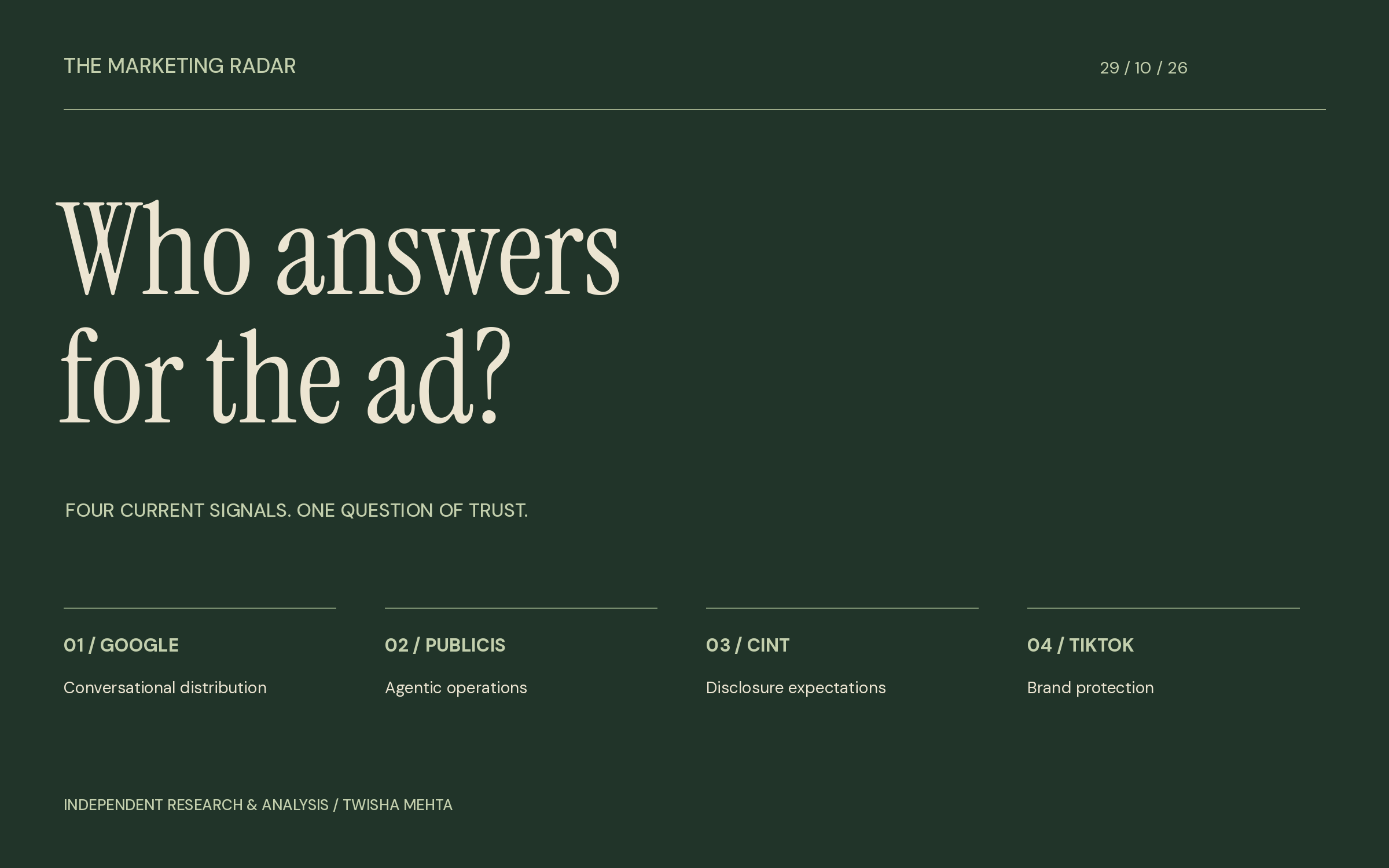
The same week can make advertising look both more automated and more dependent on judgment. Google is expanding ads inside conversational search. Publicis is putting new leadership around its agentic platform. Consumer research is raising questions about disclosure. TikTok is expanding the resources brands can use to manage reputation and AI-related risks.
These announcements address different parts of marketing. Read together, they suggest a useful briefing question: when production and distribution become more automated, where do the evidence, the explanation and the approval decision travel? That is the connecting argument in this edition, not a conclusion reported by any one source.
01 / Google: the follow-up question becomes advertising space
On 28 October, Google announced the expansion of ads in AI Mode to ten countries, including India and Canada. It separately described multiturn ads in the United States and said ads would be marked Sponsored. The market boundaries matter: the U.S. follow-up-query announcement should not be presented as a confirmed feature in every new country. [1]
The planning implication is a question, rather than a performance forecast. If a person is explaining what they need through a conversation, does the destination page answer that specific need? A broad promise may be less useful than a clear explanation of the product, its limitations and the next step. That is a recommendation about content quality; this announcement does not prove it will improve a particular advertiser’s results.
02 / Publicis: AI activation gets an organisational owner
Publicis announced on 22 October that Scott Hagedorn would become CEO and Sam Levine Archer CSO of Marcel. Its release describes expansion across areas including content intelligence, creator marketing, culture and AI-powered discovery. These are company statements about organisation and planned capabilities, not independent evidence of client growth. [2]
What I find interesting is the responsibility surrounding the technology. Once a system is expected to contribute to business decisions, the brief needs more than a request for faster output. Someone has to define which knowledge it uses, who approves the recommendation and what would count as a useful result. A product announcement can start that conversation; it cannot stand in for the evaluation.
03 / Cint: disclosure is a consumer-expectation question
Cint’s 20 October release describes research with Advertising Week involving approximately 1,000 U.S. consumers surveyed in August 2026. In that sample, 74% said brands and creators should disclose AI use in advertising, while 44% said discovering undisclosed AI-generated advertising would reduce trust in the brand. [3]
Those are reported attitudes. They are not observed lost customers, a causal estimate of sales effects or a description of Indian consumers. The useful implication for a communications team is to examine what an audience might reasonably believe it is seeing. A realistic scene can create a different expectation from an obviously illustrative graphic. Disclosure decisions should address that expectation, with appropriate review, rather than simply add the same label to every workflow.
04 / TikTok: brand protection extends beyond placement
TikTok’s 28 October announcement introduces a Brand Safety Center, a Brand Protection Playbook and AI Safety Essentials developed with Responsible Marketing Advisory. The company describes tools and guidance spanning placement controls, creator disclosure, AI transparency and reputation-related issues. The launch does not guarantee safety or establish access to every feature in every market. [4]
For PR and social teams, that broader framing is useful. A media plan can define suitable placements while a misleading edit or an unexplained creator relationship creates a separate problem. The operating question is who notices, assesses and responds across those boundaries. A new platform resource can support the process, but the organisation still needs its own decision and escalation path.
Three connections worth taking into the next brief
First, a Sponsored label and an AI disclosure answer different questions. One identifies a commercial relationship. The other explains something about how material was made or significantly altered. Neither, by itself, establishes the evidence behind a product claim. That distinction is my synthesis of the developments, not a quotation from a study.
Second, distribution and creative should be planned together. Conversational search, a creator’s recommendation and a brand’s own page carry different expectations. A message needs an appropriate destination and enough context to remain understandable when it reaches another format. More placements do not automatically create a more coherent explanation.
Third, speed makes the approval boundary more important to define. If material can be adapted quickly, a team should know which changes require another review. A new claim, a different product depiction or a change in the apparent speaker can affect what the audience understands. Treating every adaptation as an interchangeable asset misses those differences.
A practical PR decision to make before launch
I would add four short fields to the next communications brief: the verified claim and its source; what the visual depicts; the person responsible for approval; and the route for correcting a published error. This is an editorial recommendation, not a claim that a checklist guarantees trust or meets every legal obligation.
The point is to keep the important context close to the work. A campaign can have an efficient production process and still leave its audience unsure about the message. A platform can introduce more controls while the advertiser has not decided who uses them.
For this week’s developments, the sharper question is not only what the tools can produce or where they can place it. It is whether the organisation can explain and stand behind what reaches the audience.
Sources & context.
01Reported campaign details and an independent marketing interpretation. Featuring a brand does not imply a client relationship or endorsement.