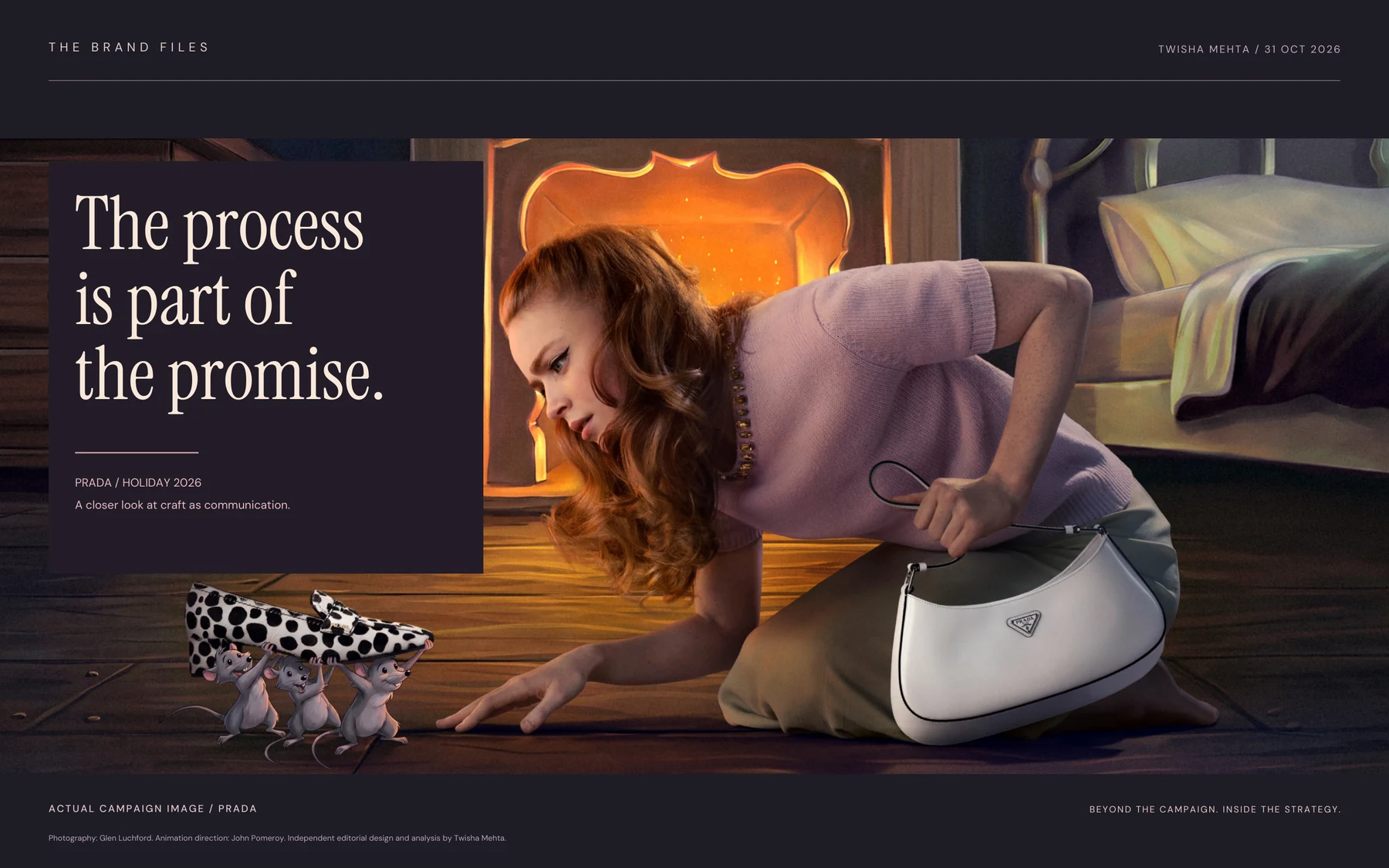
Prada's holiday campaign makes an interesting strategic proposition: the way an advertisement is made can help explain the brand it advertises. That connection deserves attention because production decisions often disappear behind a finished image. Here, making is part of what an audience is invited to notice.
Listen to the audio edition: The Brand Files — Episode 01: Why Prada Chose Hand-Drawn Animation. A 7-minute, 34-second independent analysis hosted by Twisha Mehta. This is not a Prada-sponsored or affiliated podcast.
The useful question is whether that visible process gives people a clearer reason to remember Prada. Beautiful execution and an effective commercial argument are related possibilities, but they are different things to evaluate.
What is verified
Prada's official Holiday 2026 material presents Drawing Prada as a combination of live action and hand-drawn illustration. It credits animation direction to John Pomeroy and photography and direction to Glen Luchford. Marketing-Interactive covered the campaign on 28 October. That is a reporting date, not an independently verified first release date. The official presentation emphasises craft and process; neither cited source establishes a sales effect. [1][2]
The analysis below examines the strategic mechanism. It does not infer commercial success from the campaign's existence or production technique.
Give the promise something people can inspect
A broad promise such as care, imagination or craftsmanship can be difficult to judge in an advertisement. An audience can read those words without learning what they mean for this particular brand. A visible production decision can offer an additional point of inspection.
My interpretation is that the chosen technique gives Prada a way to express its interest in craft through the communication itself. The viewer can consider how the image was constructed, rather than receive a statement about care on a separate title card. For a brand team, this creates a practical question: which part of the promise could the audience actually observe?
The distinction matters. Showing effort is only useful if that effort helps explain a relevant value. A complicated shoot can remain a complicated shoot. The strategic task is to make the relationship between method and meaning intelligible.
Keep the brand inside the mechanism
An unusual technique can become the most memorable thing in an advertisement. That creates an opportunity and a risk. People might remember the production story while failing to connect it to the advertiser.
I would therefore examine the campaign as a system of cues. Where does the product enter the image? Which visual relationships belong to this brand? What does a shorter edit preserve when it loses the surrounding explanation? These are evaluation questions, not claims that the campaign has solved each one.
For another brief, a useful exercise would be to remove the logo temporarily during review. If the team's explanation then collapses into a generic description of beautiful animation, the connection needs more work. Distinctive execution should strengthen recognition of the brand behind it.
Build a second story for the press
The production choice also gives communications teams a subject beyond the finished advertisement. A release can describe a technique, explain a creative decision and attribute the people who made it. That creates several possible editorial entry points.
A fashion publication might explore the relationship between the visual world and the collection. A craft or animation publication could examine the method. A marketing publication could ask why that method suits the positioning. These are potential angles; their existence does not guarantee coverage or prove audience interest.
The useful PR principle is to make the process explainable and attributable. Vague statements about being different are difficult to investigate. A clearly credited decision gives a journalist something more specific to question, illustrate and discuss.
Connect attention to a useful next step
A compelling production story still needs a commercial bridge. If an interested reader moves from a campaign article to a product page, what continuity do they encounter? The imagery, product information and shopping experience should give them a coherent route through the idea.
That does not mean every campaign needs to become a sales demonstration. It means the team should understand what the communication is meant to help someone do next. Browse a collection, understand a material, recognise a product family or return to a store are different objectives.
I would choose the intended action before designing the supporting content. Otherwise, a strong creative world can end at an attractive dead end. The connection between storytelling and distribution deserves as much deliberate work as the film itself.
Measure the link, not just the response
The sources reviewed do not provide an evaluation design or verified commercial results. It would be premature to claim that this execution increased trust, preference or willingness to pay.
A responsible test could begin with brand attribution and message understanding. After exposure, can people identify the advertiser and explain the intended value in their own words? A separate test could examine qualified product exploration, using an appropriate comparison rather than assigning all subsequent activity to the campaign.
Public reactions can offer questions for further investigation. They cannot stand in for a representative study. The measurement plan should also separate admiration for a technique from interest in what the brand sells.
A practical application for smaller teams
The transferable lesson is not to commission the same production style. It is to choose a method that makes a relevant promise easier to inspect.
A food business might show the preparation decision that affects the serving experience. A service firm could explain how a difficult brief becomes a useful recommendation. A product maker could reveal a detail that matters in use. These are illustrative applications, not claims about live campaigns.
Before production, write three short answers: the promise, the visible evidence and the next useful action. If the evidence does not support the promise, revise the concept. If the next action has no connection to either, revise the distribution plan.
Prada's campaign offers a productive question for any brief: can the work of making the communication also make the brand's meaning clearer? That is a more demanding standard than looking impressive, and a useful one to carry into the next creative review.
Sources & context.
01Reported campaign details and an independent marketing interpretation. Featuring a brand does not imply a client relationship or endorsement.