A box of chocolate is an unusually revealing branding problem. It is already a familiar gift. But during a festival, familiarity can become a weakness: when every premium brand promises delight and celebration, the category starts speaking in one voice. How can a known favourite feel newly considered without disguising what it is?
That is the tension behind ROYCE’ India's “Not quite ordinary” Diwali campaign. The work is not simply louder festive advertising. It is an attempt to make familiarity and surprise coexist.
What launched
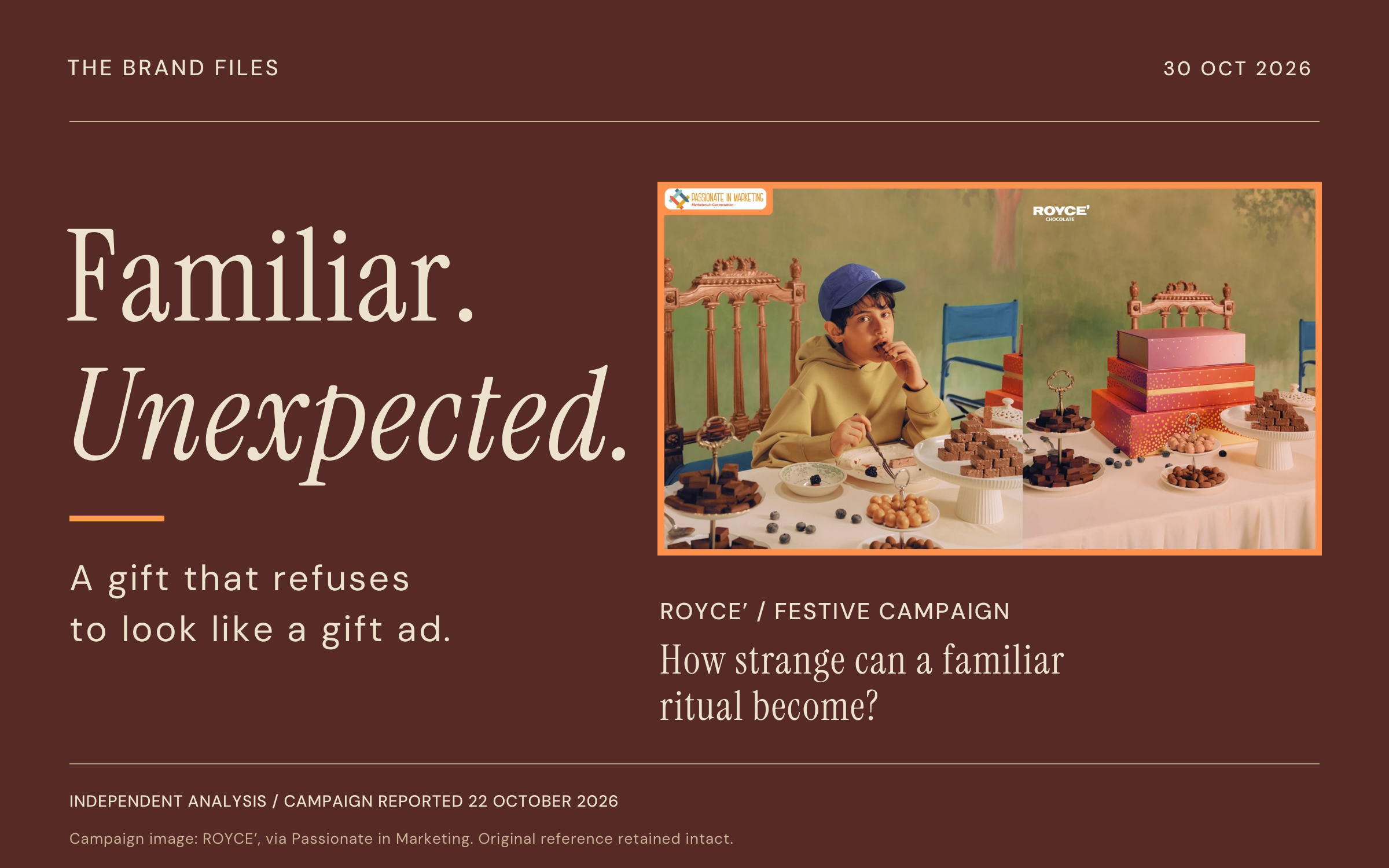
Passionate in Marketing reported the work on 22 October 2026. Its description centres on unusual settings, distinctive characters and theatrical styling, developed with creative director Pranoy Sarkar and stylist Devanshi Tuli. The campaign's proposition is that an established favourite can still offer surprise. These are reported creative choices, not evidence of commercial effectiveness. [1]
The creative world matters because it refuses to treat a gift as an interchangeable symbol of generosity. Instead of relying exclusively on familiar festive visual codes, the campaign offers encounters and situations that feel a little unexpected. The product remains recognisable within that imaginative environment.
ROYCE's official India storefront also presents a Diwali gift collection. This is a separate piece of product context, not proof of the campaign's impact. [2] A useful strategic question connects them: does the experience of choosing and giving the product deliver the care suggested by the advertisement? That is a question to investigate, not an outcome established by the imagery.
The psychology of a considered gift
A gift does more than transfer an object. It communicates something about the relationship between the giver and recipient. The giver wants the recipient to believe that the choice was made deliberately. A familiar premium chocolate can help because it carries established expectations of quality. But it can also look predictable.
My interpretation is that ROYCE’ is trying to resolve this contradiction. The chocolate is familiar enough to feel safe, while the surrounding creative and packaging promise a moment of discovery. This creates a more specific emotional proposition than simply claiming luxury.
It also shifts the emphasis from the brand's status to the buyer's discernment. The purchase becomes a statement about knowing what someone might enjoy. That reading is an analytical hypothesis, not an established consumer research result.
Why the unusual creative matters
Surreal imagery is not inherently strategic. It becomes strategic when the visual form expresses the proposition. Here, the message is that an established favourite need not feel ordinary. The unexpected world embodies that claim.
This matters because festival advertising is often visually crowded with similar signals. Familiar celebrations can communicate cultural relevance but make individual executions harder to distinguish. The ROYCE’ approach attempts to create a second look without discarding recognisable product cues.
The delicate balance is between surprise and attribution. If the audience remembers the unusual characters but cannot name the chocolate brand, the campaign may have created entertainment rather than useful brand memory. Distinctiveness is valuable only when people connect it to the right advertiser.
The commercial decision beneath the art direction
Premium gifting has at least two relevant audiences: people who already know the product and people considering it for the first time. For existing buyers, a fresh visual world may supply a reason to reconsider a familiar purchase. For new buyers, it may signal a more distinctive gift choice.
Packaging can carry that promise through to the moment of exchange. If the recipient sees the box as special before opening it, the physical experience can reinforce the story the advertising told. Yet packaging also adds complexity and cost. A distinctive gifting presentation does not automatically create incremental demand.
A useful commercial analysis would compare gift consideration, product-page engagement, conversion and repeat purchase across relevant audiences. The published campaign report does not supply these results.
Where the idea could fail
There are at least three risks. First, novelty can overshadow the product. Second, a highly designed presentation may make a gift feel less approachable or less suitable for certain recipients. Third, a seasonal execution may win attention without changing longer-term brand preference.
The campaign's launch is not proof of success. We do not have independently verified reach, brand-lift data, incremental revenue or a controlled comparison against conventional festive creative. Even positive social reactions would not by themselves establish sales effects.
The question is not whether the campaign looks different. It is whether the difference improves recognition and choice.
How I would test it
Start with two hypotheses. Unexpected imagery might increase attention while preserving correct brand attribution. Recipient-centred gifting cues might increase consideration more than generic festive celebration imagery.
Test these separately. Expose comparable audiences to the alternative creatives, then assess unprompted brand recall, gift relevance and purchase consideration. In market, compare qualified visits and incremental orders while controlling for audience, budget, distribution and promotions.
For the packaging, survey actual purchasers and recipients about perceived thoughtfulness, visual appeal and whether the product matched expectations. Split first-time customers from repeat buyers. These proposed measures are a research plan, not results ROYCE’ has published.
What marketers can learn
First, identify the social job of the purchase. A gift is partly a message about the recipient, not only a product category. Second, use art direction to express a precise strategic claim. Unusual imagery should be more than decoration. Third, make the physical experience deliver the advertising's promise. A campaign cannot compensate indefinitely for a disappointing handover or product experience.
Finally, preserve the difference between creative judgment and commercial proof. An execution can be thoughtful, distinctive and worthy of study without anyone knowing whether it generated incremental growth.
The most useful lesson is not that every premium brand should become surreal. It is that established familiarity can be an asset to reinterpret rather than a constraint to escape. ROYCE’ offers an interesting example of that choice. Whether the choice improved business outcomes remains an open question.
Sources & context.
01Reported campaign details and an independent marketing interpretation. Featuring a brand does not imply a client relationship or endorsement.