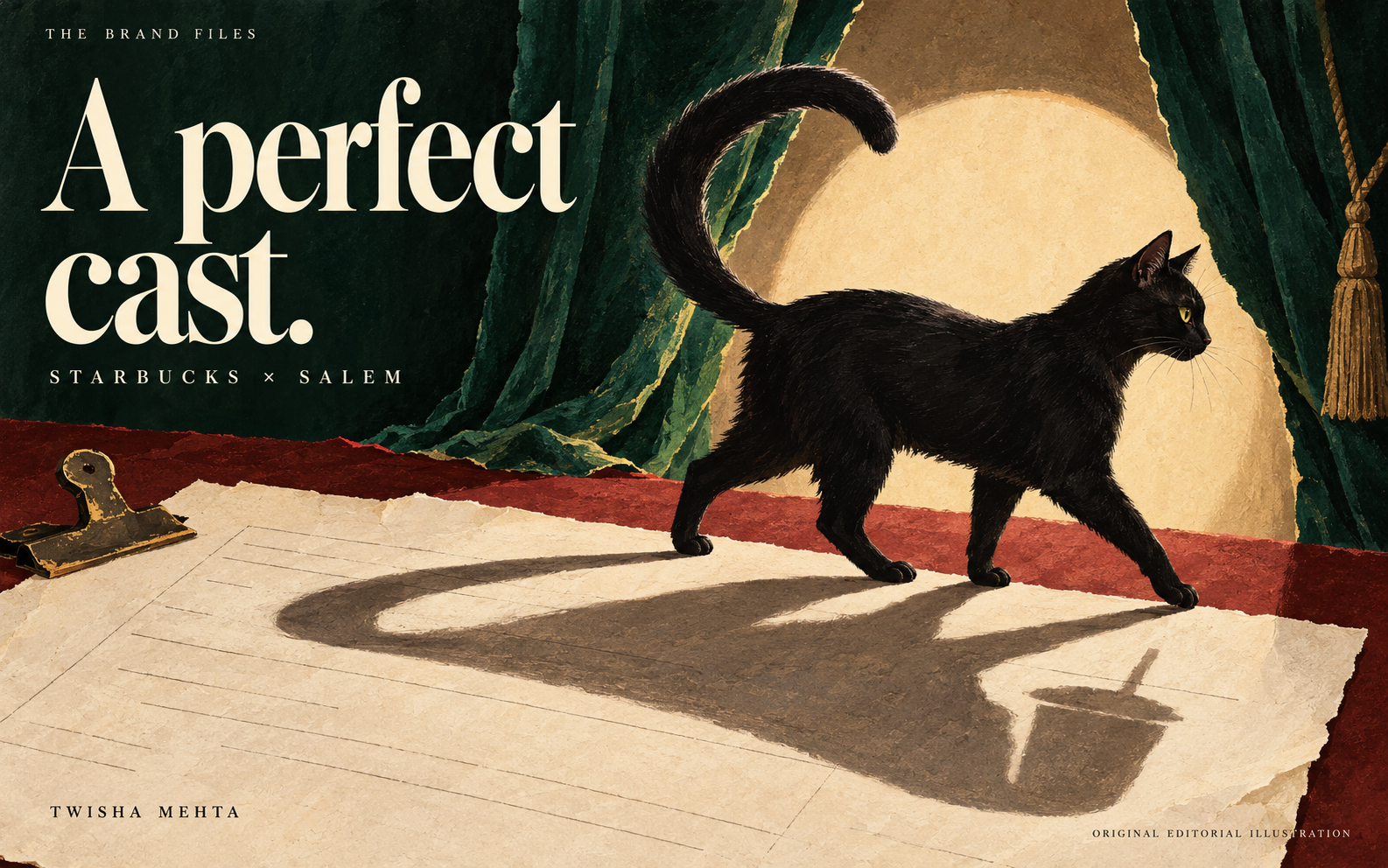
A black cat is a familiar Halloween shortcut. What makes Starbucks’ latest use of one worth examining is the connection between the character, the drink and the occasion. The campaign does not ask the audience to connect three unrelated ideas. The product gives the character a reason to be there.
Starbucks announced its Black Cat Frappuccino on 21 October, with a 22 October launch through Halloween at select U.S. coffeehouses. Its chocolate cat-ear topping makes the name visible in the product. The launch also enlisted Salem from Sabrina the Teenage Witch. These are details from the company’s announcement, not an assessment of the campaign’s performance. [1]
The casting decision starts in the cup
Celebrity and character partnerships are often discussed in terms of recognition. How many people know the face? Which audience comes with it? Those are useful questions, but they can leave the actual creative connection underdeveloped. An audience can recognise a spokesperson without understanding why that spokesperson belongs in this particular advertisement.
Here, the connection is unusually easy to explain. The drink is a black cat. Salem is a black cat. The occasion gives both a place in the same story. My interpretation is that this reduces the amount of explanation the campaign needs before it can develop a tone of its own. That is a creative hypothesis, not a measured finding about audience comprehension.
The simplest test is substitution. Replace Salem with an equally well-known but unrelated character. Does the idea remain almost unchanged? If it does, the partnership may be supplying recognition more than meaning. In this case, the shared character and product idea would become harder to preserve.
A character can bring a voice, not only a silhouette
Archie Comics’ character profile describes Salem’s speech and sarcastic personality, and explains how the 1990s television version helped establish his familiar black fur and sharp manner. That gives the casting more to work with than the appearance of a generic Halloween cat. [2]
A useful spokesperson can influence what the brand says and how it says it. An opinionated character can comment on a treat, be difficult to impress or turn approval into a small scene. Those are possible writing directions supplied by the character. They are not claims that I independently watched every campaign execution or that viewers responded in a particular way.
For a creative team, that distinction matters. A strong casting rationale should generate actual decisions: a line, an interaction, a point of view. If the partnership can only produce a name on the announcement, the idea may need more development before production begins.
Product design does part of the communication
The chocolate ears matter because the product can still carry the idea when the spokesperson is absent. A product photograph has a different job from a film. A customer’s image has another. The physical detail gives those formats something concrete to show without requiring the full campaign narrative beside them.
That does not establish how recognisable the drink is to a particular audience. It suggests a useful question for a brief: what detail lets the idea survive outside the hero execution? It might be a shape, a use, a sound or a specific interaction. The answer should come from the product or experience, rather than from an extra layer of decoration added to every asset.
There is a practical limit too. A detail that works in a styled image has to be deliverable at the point of purchase. This article does not verify store execution, customer experience or product consistency. Those would require their own evidence.
The PR story needs a reason to be a story
A character returning for an occasion offers a press angle beyond a product arriving on a menu. The launch announcement makes that return part of its framing. From a PR perspective, the interesting question is whether the relationship can be explained in one sentence without a long argument about audience overlap.
An earned-media plan could develop that connection through the product design, the character’s established personality and the cultural timing. It should still distinguish the brand’s intended story from what journalists or audiences actually discuss. A press release being published does not prove the intended association travelled with it.
The measurement plan would therefore need more than a coverage count. I would examine whether coverage connects the character to the product, which details people retain, and whether a character-led execution improves recall compared with a product-only version under comparable conditions. These are proposed evaluation questions, not results from this launch.
The lesson is fit, not a formula
This is not a recommendation that every seasonal campaign needs a nostalgic character. Familiarity can distract, the partnership may be expensive, and not every audience shares the same reference. The public sources reviewed do not provide sales, brand-lift or reach figures that would justify calling the execution a commercial success.
What is useful is the order of the decision. Start with the product and the occasion. Ask which character could make that particular idea more expressive. Then write the execution and decide what evidence would help evaluate it.
The strongest question is a small one: if the partner disappeared, what would the campaign lose? An answer about the actual idea is more useful than an answer about the size of the audience.
Sources & context.
01Reported campaign details and an independent marketing interpretation. Featuring a brand does not imply a client relationship or endorsement.